Self-Distilling Future Video Representations for World Action Models

Huiwon Jang1,2*, Suhyeok Jang1,2*, Sihyun Yu1, Hyeonmo Kang1, Seungku Kim1, Jinwoo Shin1,2
1KAIST, 2RLWRLD
*Equal Contribution

TL;DR: We introduce FRED, a framework that trains World Action Models to generate better future video representations in a single denoising step by self-distilling from noisy ground-truth futures and conditioning on observation history.

Abstract

World Action Models (WAMs) have emerged as a promising approach to learning generalist robot policies using rich spatiotemporal priors from pre-trained video diffusion models. A recent line of WAMs improves inference efficiency by conditioning a separate action decoder on intermediate future video representations extracted from a single denoising step, avoiding costly iterative denoising required for video generation. This design makes action prediction depend directly on the quality of these future representations. In this paper, we introduce Future REpresentation learning via self-Distillation with temporal context (FRED), a framework that trains WAMs to improve the quality of future video representations from noise in a single denoising step. Specifically, FRED uses self-distillation to predict future representations from noise, using representations extracted from ground-truth future observations as targets. We further condition the video model on historical observations, providing temporal context for predicting future representations better. Across diverse real-world manipulation scenarios, FRED consistently outperforms competing WAMs. It achieves particularly large gains on long-horizon and out-of-domain tasks under zero-shot environment generalization, and substantially improves human-to-robot skill transfer, reaching 50.0% task success on tasks absent from robot training data and demonstrated only in human videos, compared with 19.4% for the best competing WAM.

Method overview

FRED builds on recent WAMs that keep the pre-trained video diffusion model (VDM) $\mathbf{v}_\theta$ unchanged and use a separate diffusion-based action decoder $\pi_\phi(\mathbf{a}_t \mid \mathbf{q}_t, \mathbf{h})$, where $\mathbf{h}$ is an intermediate hidden state of $\mathbf{v}_\theta$ obtained through a single forward pass from Gaussian noise $\boldsymbol{\epsilon}$. This avoids iterative video denoising at inference, but policy performance now depends on how well $\mathbf{h}$ captures the future.

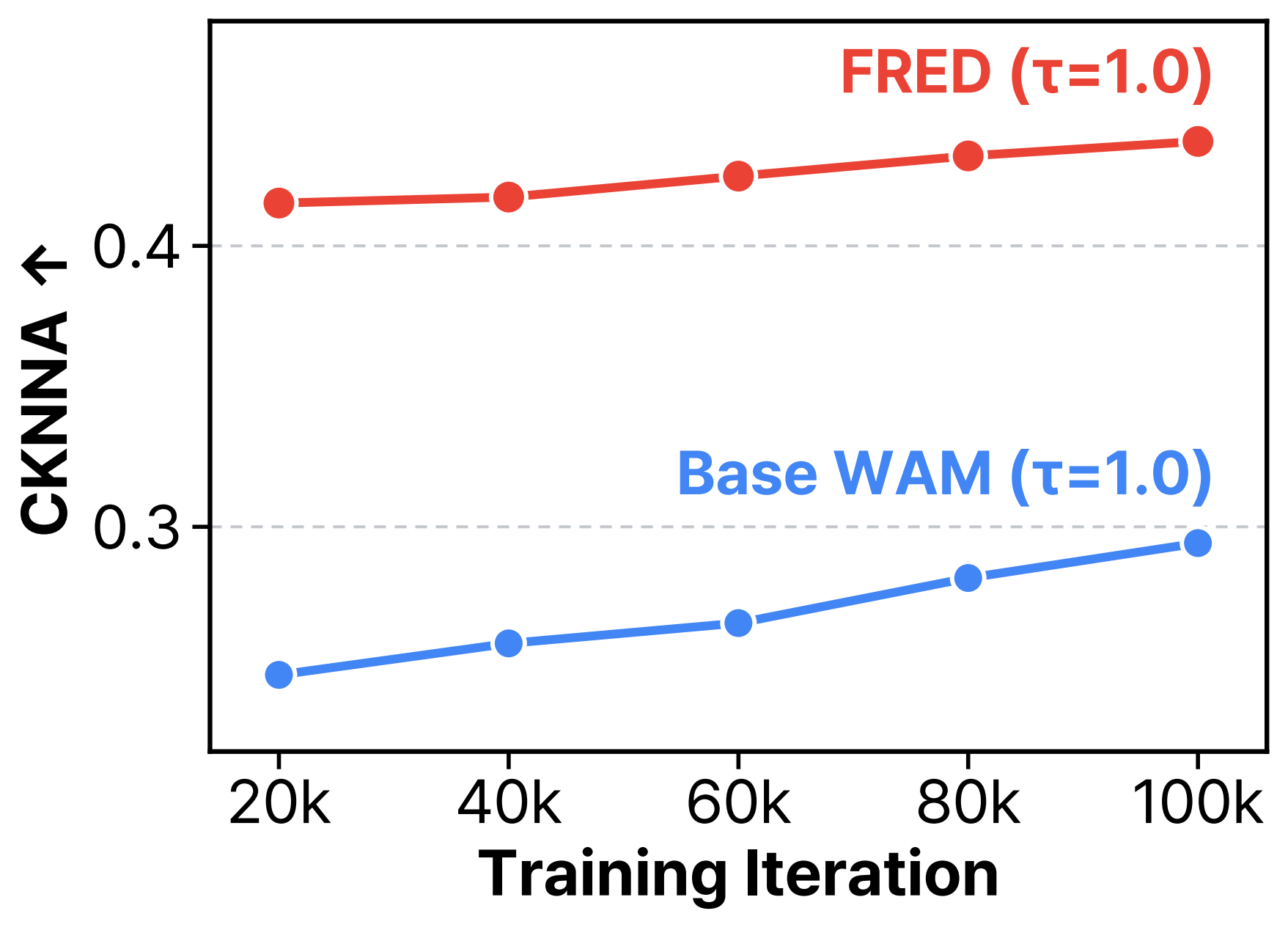
Observation. Video model learns future representations during WAM training. Using DiT4DiT as the base WAM on RoboCasa Kitchen, we probe $\mathbf{h}$ generated from noise with a lightweight attentive probe that classifies future motion primitives, and measure its structural similarity to representations of clean future observations with CKNNA. Both increase throughout WAM training, showing that the video model progressively learns to generate future representations from noise, but a clear gap to clean-future representations remains.
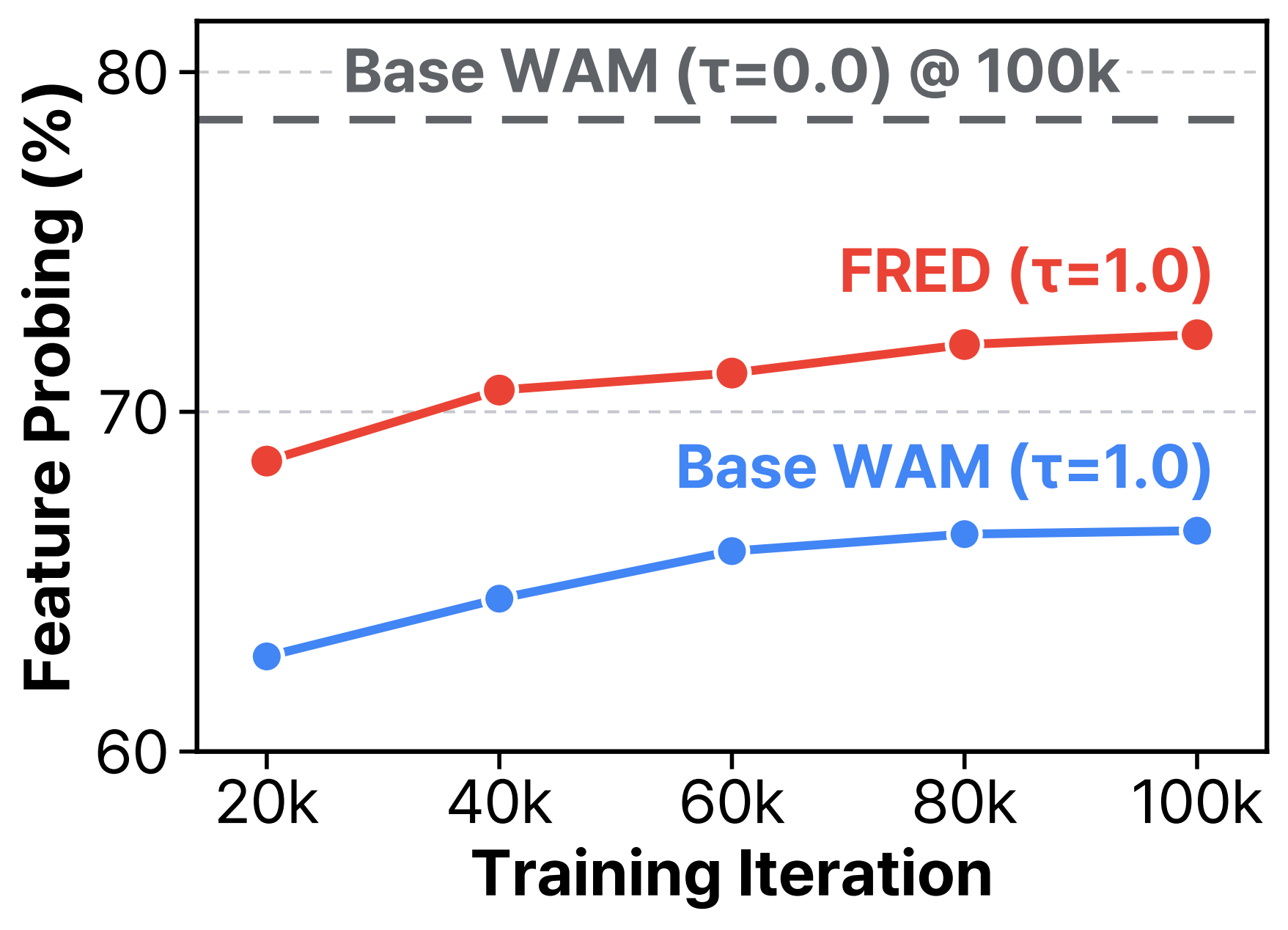
Future-motion probing accuracy of video-model hidden states versus training iteration
CKNNA between representations generated from noise and representations of clean future observations versus training iteration

We therefore interpret the video diffusion model as a future representation generator, $\mathbf{h} = \mathbf{f}_\theta(\boldsymbol{\epsilon} \mid \mathbf{o}_t, \mathbf{c})$, where $\mathbf{f}_\theta$ denotes the first layers of $\mathbf{v}_\theta$ that output $\mathbf{h}$ given the observation $\mathbf{o}_t$ and instruction $\mathbf{c}$, and FRED improves $\mathbf{h}$ with two components: self-distillation from noisy future observations, and a short observation history as temporal context. As shown above, FRED reduces the probing gap and further improves the structural similarity.
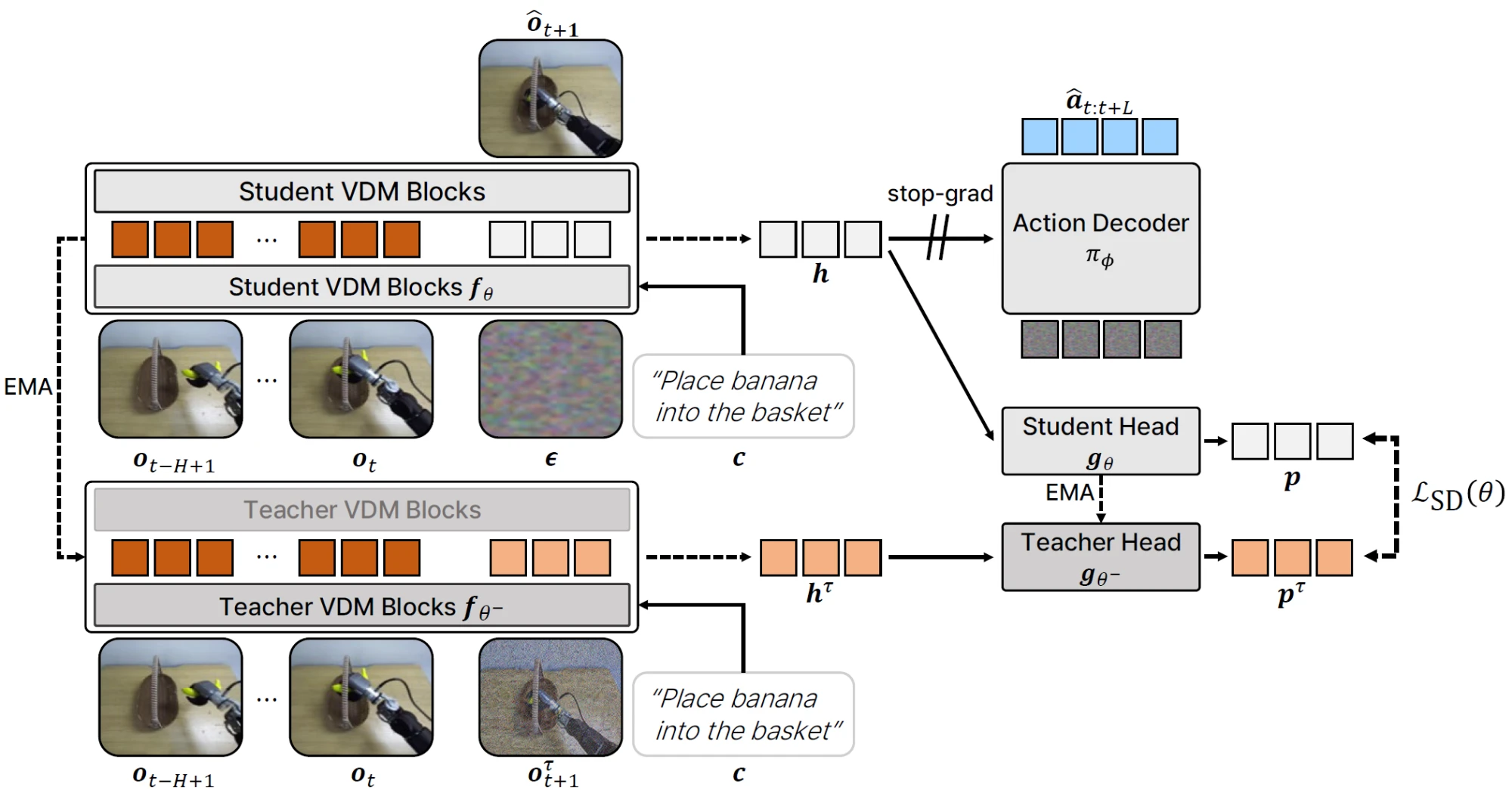
Overview of FRED

Self-distillation from noisy futures. The student $\mathbf{f}_\theta$ generates $\mathbf{h}$ from noise, while a momentum teacher $\mathbf{f}_{\theta^{-}}$ processes a lightly corrupted ground-truth future observation $\mathbf{o}^\tau_{t+1} = (1-\tau)\,\mathbf{o}_{t+1} + \tau\,\boldsymbol{\epsilon}$ under the same conditioning to produce the target $\mathbf{h}^\tau$:

$\mathbf{h} = \mathbf{f}_\theta(\boldsymbol{\epsilon} \mid \mathbf{o}_{t-H:t}, \mathbf{c}) \quad \text{and} \quad \mathbf{h}^\tau = \mathbf{f}_{\theta^{-}}(\mathbf{o}^\tau_{t+1} \mid \mathbf{o}_{t-H:t}, \mathbf{c})$

Patch-wise projection heads $\mathbf{g}_\theta, \mathbf{g}_{\theta^{-}}$ map both representations to distributions; the teacher logits are centered by the mean teacher logits $\mathbf{m}$ and sharpened with a lower temperature $\gamma_2$ to prevent representation collapse. The self-distillation loss is a per-patch KL divergence:

$\mathbf{p} = \mathrm{softmax}\!\left(\mathbf{g}_\theta(\mathbf{h}) / \gamma_1\right), \quad \mathbf{p}^\tau = \mathrm{softmax}\!\left((\mathbf{g}_{\theta^{-}}(\mathbf{h}^\tau) - \mathbf{m}) / \gamma_2\right), \quad \mathcal{L}_{\mathrm{SD}}(\theta) = \frac{1}{N} \sum_{i=1}^{N} \mathrm{KL}\!\left(\mathbf{p}^\tau_i \,\|\, \mathbf{p}_i\right)$

History as temporal context. Both student and teacher are conditioned on a short history $\mathbf{o}_{t-H:t}$ rather than only the current frame, which provides motion cues (e.g., where the arm is heading) that disambiguate the future.

Training objective. The video model is trained with the video flow-matching loss plus self-distillation, and the action decoder with its own flow-matching loss. The action loss does not update the video model, so the representation generator $\mathbf{f}_\theta$ is trained only by the video generation and self-distillation objectives; the teacher is the EMA of the student, $\theta^{-} \leftarrow m\theta^{-} + (1-m)\theta$.

$\mathcal{L}_{\text{video}}(\theta) = \mathcal{L}_{\mathrm{FM}}(\theta) + \lambda_{\mathrm{SD}}\,\mathcal{L}_{\mathrm{SD}}(\theta) \quad \text{and} \quad \mathcal{L}_{\text{action}}(\phi) = \mathcal{L}_{\mathrm{FM}}(\phi)$
Real-world experiments

Training and evaluation setup

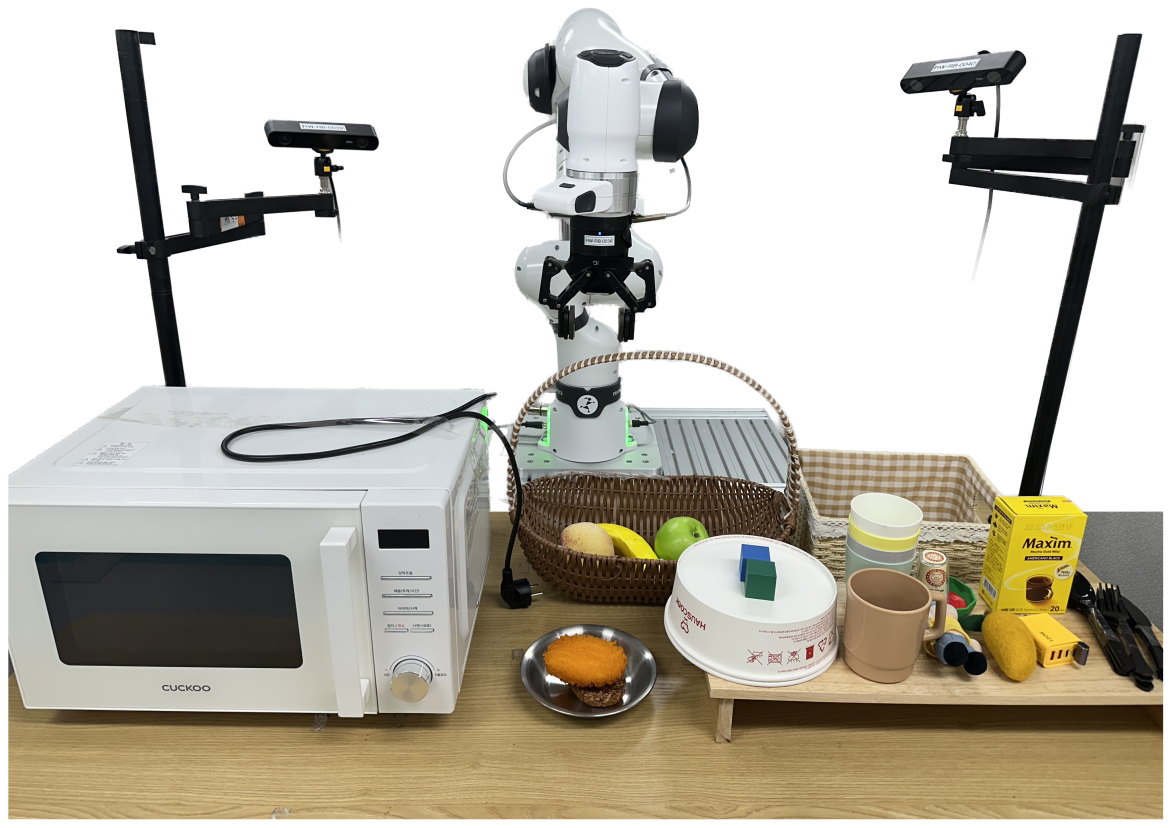
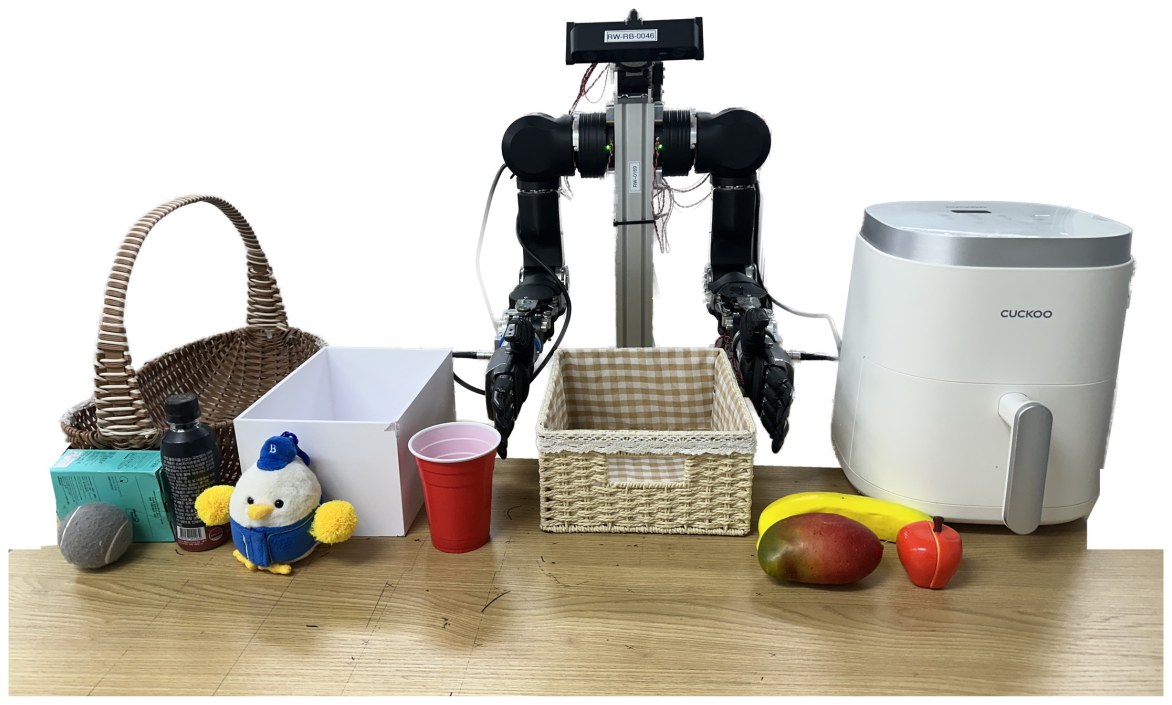
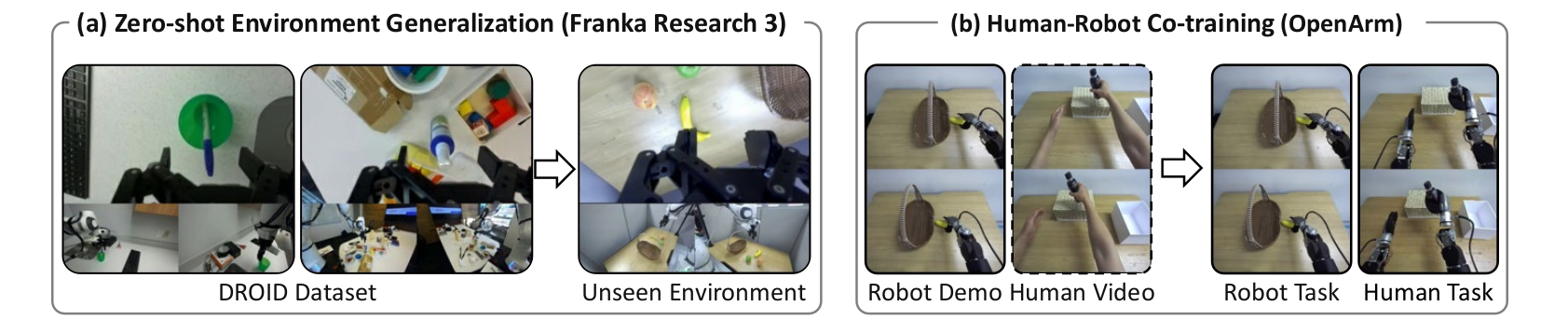
(a) Zero-shot environment generalization: train on DROID and evaluate in a new real-world environment on a Franka Research 3 without task-specific fine-tuning. (b) Human-robot co-training: train an OpenArm humanoid on robot demonstrations, optionally jointly with egocentric human videos, and evaluate on in-domain robot tasks and human-to-robot skill-transfer tasks.

Zero-shot Environment Generalization Results (DROID)

MethodBackboneIn-domain easyIn-domain long-horizonOut-of-domainObject grounding
$\pi_{0.5}$–58.353.316.716.7
GR00T N1.7–41.760.018.822.9
Fast-WAMWan2.2-5B26.426.72.110.4
DiT4DiTWan2.2-5B16.716.70.08.3
AGRAWan2.2-5B41.731.710.433.3
FRED (Ours)Wan2.2-5B47.246.737.537.5
DreamZeroWan2.1-14B63.961.710.439.6
FRED (Ours)Wan2.1-14B79.281.752.154.2

All rollout videos below are played at real-time speed (1×).

Real-robot rollouts (FRED 14B)

1×
PnP Banana
1×
PnP Cube
1×
Open Microwave
1×
Close Microwave

Inference speed comparison: FRED 14B vs. DreamZero 14B (Stamp, 1×)

1×

Human-robot Co-training Results (OpenArm humanoid)

(a) In-domain robot tasks

MethodAtomicComposite
w/o humanw/ humanw/o humanw/ human
$\pi_{0.5}$66.7–50.0–
GR00T N1.791.7–45.8–
DreamZero68.168.10.00.0
Fast-WAM56.965.30.00.0
DiT4DiT77.886.150.041.7
AGRA81.975.08.312.5
FRED (Ours)91.797.270.875.0

(b) Human skill transfer tasks

MethodTask successInstruction following
w/o humanw/ humanw/o humanw/ human
$\pi_{0.5}$0.0–16.7–
GR00T N1.75.6–33.3–
DreamZero0.00.00.013.9
Fast-WAM0.00.00.011.1
DiT4DiT0.019.40.055.6
AGRA0.00.00.00.0
FRED (Ours)0.050.00.097.2

Real-robot rollouts (FRED 5B)

PnP Banana
Open/Close Air Fryer
PnP Apple/Mango

Analysis

Quality of generated future representations correlates with control performance

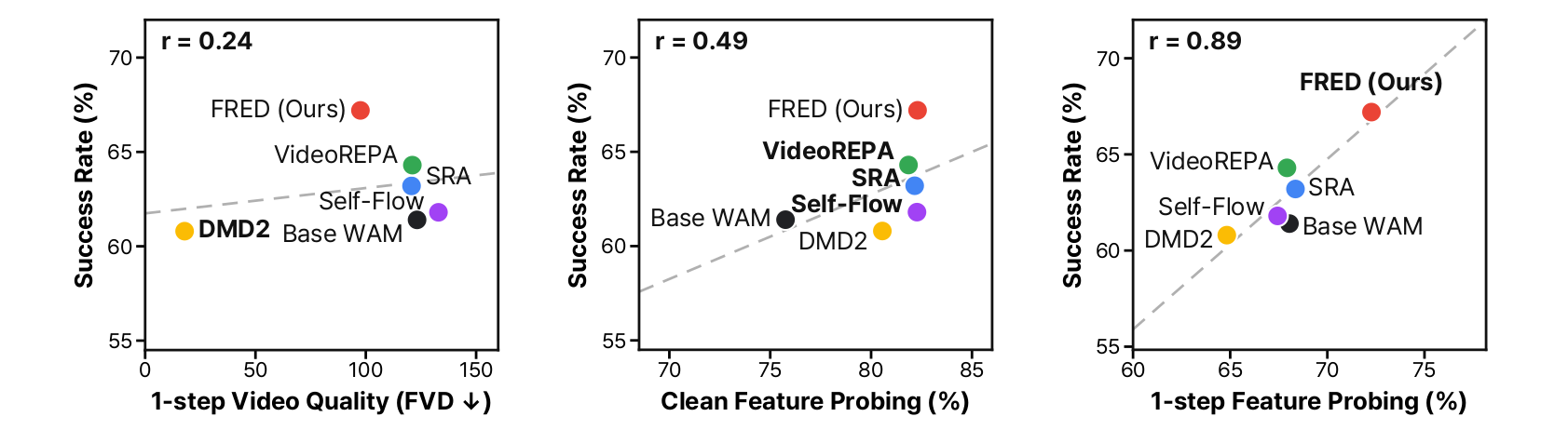
Success rate versus one-step video quality, clean-feature probing, and one-step feature probing

Using DiT4DiT as the base WAM on RoboCasa Kitchen, task success is only weakly correlated with (a) one-step video generation quality ($r=0.24$) and (b) the quality of representations extracted from observed future videos ($r=0.49$), but strongly correlated with (c) the quality of future representations generated from noise in one step ($r=0.89$).

We compare WAM variants trained with different video-model objectives, from one-step video distillation (DMD2) to representation learning (VideoREPA, SRA, Self-Flow), along three dimensions. Task success is only weakly correlated with one-step video generation quality and with representation quality on observed future videos, but strongly correlated with the quality of future representations generated from noise. Improving the representations that are directly used for action generation is therefore what matters for control, and this is what FRED targets.

Hardware setup

DROID evaluation setup

Franka Research 3 with a Robotiq 2F-85 gripper, a wrist camera, and left/right exterior cameras. Actions are relative joint angles (7D) and absolute gripper opening (1D).

OpenArm evaluation setup

OpenArm humanoid with two 7-DoF arms, 6-DoF Inspire RH56F1 hands, and a ZED 2i stereo camera on a 2-DoF neck; both egocentric views are used as input.